
The decisive element

 By now the www interconnects, links most of the world’s population.
At the beginning of the twentieth century Rudolf Steiner reawakened awareness for a totally different human network. Many of his profound spiritual investigations regarding karma and reincarnation have remained almost unnoticed by the world at large. They not only cast light on the karmic connectedness of individuals, but also on world karma tying together the human being, the earth and the angelic realms.
According to a legend, Mary and Joseph and the child, pursued by Herod’s soldiers, sought refuge in a cave. At once a spider weaves a web over the entrance. Seeing the spider web, the soldiers believe that surely no one is hiding in the cave. The next morning, before the holy family moves on, the child thanks the spider in the web by drawing a cross on its back. Through the spider’s act of rescue, it has unknowingly saved the child for his later death, the death upon the cross. In this way, the web at the entrance of the cave became a worldwide web of destiny for God, the human being and the earth.
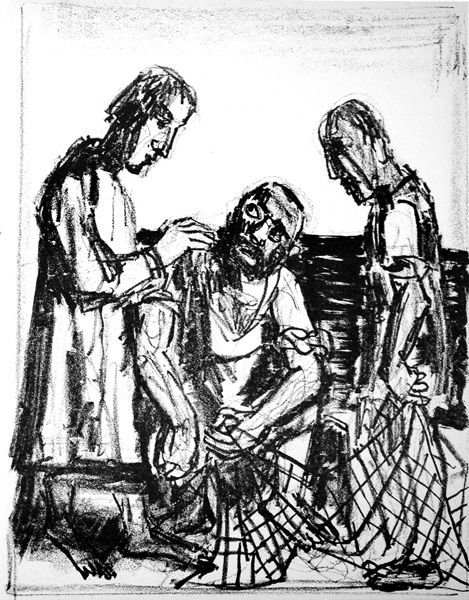
At the turning point of time, shortly after his baptism in the Jordan, Christ Jesus walks on the shore of the Sea of Galilee. There he finds fishermen casting, mending and washing their nets. He calls them and they follow him. Familiar with handling and caring for the net, they are apparently suitable to become his disciples.
In the third millennium, one can only wish that human beings becoming familiar with the handling and care of the entanglements, intermeshing and interconnectedness of karma, would increasingly haul up from the depth of the sea of destiny genuinely new insights on how to mend and repair social and karmic tears and tangles. To come upon such a ‘catch of insight’ will require more than to fish with our web browsers in a sea of information.
Reposted from Facebook with permission. LM
Artwork: The Calling of Peter by Otto Dix from the book Matthäus Evangelium (out of print)

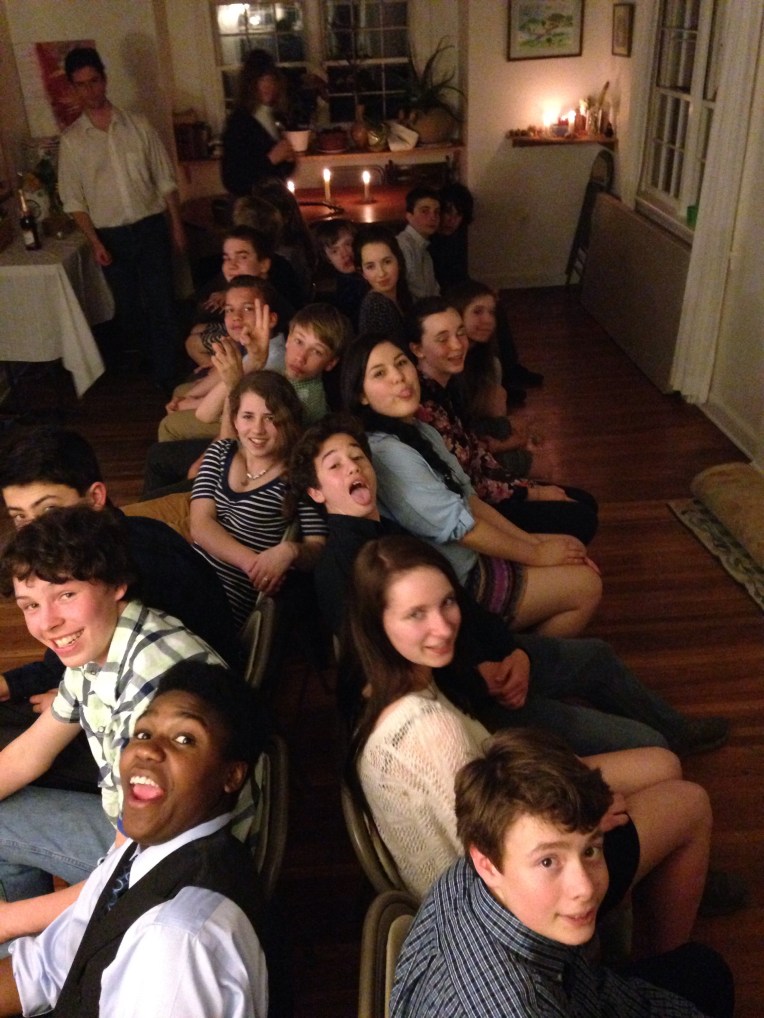
I am on a retreat for those about to be confirmed in The Christian Community, with 19 fourteen year olds from congregations in the eastern United States. It is always so moving to me to be with these youngsters, full of life and expectation about all that is to come. What grace allows these kids of today to still be open to our adult guidance, to our serious and challenging questions? I have learned a few things over the years of working with the young, and with other colleagues. Our shared general approach as Christian Community priests is to view the confirmands as people on the threshold between childhood and youth, beginning a new life and starting to become themselves for the first time in their lives, independent and scared and full of joy at the possibilities. We work out of a reverence for the evolving free, spiritual human being who already appears in such sincerity even at this age. They are pilgrims on a pressing journey to find the divine at work in the world.
What strikes me every time I enter such a happening (an extended trip such as this for example) is to notice just how serious they are in their approach to life–mixed in with the usual teenager energy and general discomfort that all us human beings seem to have to go through at this age–they are desperately hungry for the truth, to learn what is essential to make it in this life, how to make meaning out of struggle, how to find joy and satisfaction in their engagement and relationships, and whether or not the spiritual world is real, as real as what happens here on earth. They are worried about high school, what people think of them, whether or not there is a place for them in this complicated world.
They look to us in sincere longing to know that we grownups stand for what we speak of, that we are authentic in our own striving, that we love the earth and other people and life itself and also have some kind of real relationship to God and spirit.
They are as serious as monks, though you wouldn’t know it during dinner, when the din of their ebullience in the room is deafening! But the moment we give them the task of drawing a Celtic sun cross in their books or the exercise to pray for five straight minutes and then write about their experience, they take it on with a reverence and quietude of soul which challenges many an adult to find. I am in awe of them. I feel a deep gratitude to be allowed to try to serve their becoming, and a desire to become so much more than I already am to be worthy of this task.
John 20: 1-20
The Easter question is: Who can see the Risen One? And after the great death through which we again have gone: who can feel the Easter joy? Filled with love and grief, Mary Magdalene comes to the tomb early in the morning on the First Day. She sees in the dim first light of this day that the stone has been moved away—and from this she infers that they have taken away the Lord! But she has not seen it. Her eyes are still in the grave—they cannot yet see. Where is He?
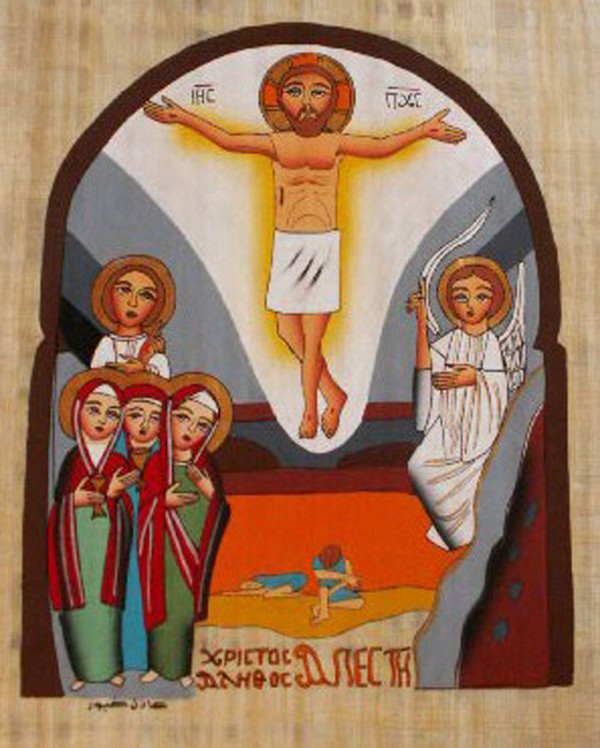 Running to Simon Peter and Lazarus John, she reports it, and they too come, but they cannot see more than some cloths inside the grave. Now it begins to dawn on them what they had heard might in fact be true: that He would be raised from the dead. But where is He? They cannot see.
Mary, however, remains at the grave. In her grief and not knowing how to see, she weeps. And then she sees the angels, who ask her, Woman, why are you weeping? Still in the grave, she cannot really see! And in this not knowing which she cries out for the second time, she turns. A change begins. There she sees the one she takes to be the Gardener. He too asks, Woman, why are you weeping? And for a third time, she cries out in her not-knowing, this time with a plea to please bring Him back. And it is through this that the Lord can name her, like a baptism, and awakens her to sight. Then she can say: “I have seen the Lord…”
Our eyes mostly cannot see the spirit. The Resurrection is an open Mystery because it has been placed before us as an objective world fact, but our eyes remain in the grave. They are not alone in there. Not only our eyes, but our ears and speech and our hearts are in the grave. We hold to death and dead things, because we think we can count on them. But the grave is empty—He is not there! So where can we find Him?
The secret lies in finding our own activity, to learn to seek Him. We teach the children: the Spirit of God will be with you when you seek Him. And their most important response, their religious practice is their reply: I will seek Him! How can we renew our eyes? We can seek. We can praise. We can pray. We can stand at the grave not knowing, and weeping, and opening our hearts, and we can begin to turn the grave into an altar.
At the grave of all we cannot yet do, we can make an altar to the One who we long to see with our eyes, to see with our hearts. We can think the Risen One, we can feel the Risen One, and we can pray the Risen One. We can offer ourselves to Him in this way, as He offers Himself to us. In the grave we must say: He is not here. At the altar we can say, He is Risen! And I will seek Him!
Getting ready for tomorrow, I found this poem in the latest issue of Parabola from Mary Oliver:
Moments
There are moments that cry out to be fulfilled.
Like, telling someone you love them.
Or giving your money away, all of it.
Your heart is beating, isn’t it?
You’re not in chains, are you?
There is nothing more pathetic than caution
when headlong might save a life,
even, possibly, your own.
John 19:35 And the one who has seen bears witness and his witness is true; and he has perceived that he is telling the truth, so that you also may find faith.
John the Baptist came to bear witness that the Christ, the Son of God, the Logos was coming into the world. He bore witness so that he could help prepare the way for the coming of God into our own midst, into the very center of our own being. John was the highest born of women, that is, he was almost an angel but still a human being. He was in a sense the best of what was possible for human beings to become out of the past.
Even after his death, he remained united with the circle around the Christ. He continued to bear witness and to hold a kind of over-consciousness for the group who moved with Christ but did not yet understand him and all that he had to bring.
In the middle of the Gospel of John we witness the transformation of another young man who had reached a certain level of preparation by following the rights and practices of his religious culture. He had prepared his soul to be able to ask the question “Now how do I attain eternal life?” And it is through a deathlike experience, an initiation into a new kind of being that Lazarus is called into a new life, becoming the very first new human being, reborn through the spirit of Christ, that is, awakened in Christ in him.
This happens before Christ Jesus goes through death and resurrection and becomes the new “Adam,” the new ancestor for all future human beings, through whom the forces of death can be overcome. It is therefore right to call the raising of Lazarus a miracle, because it happens before Christ’s own resurrection, so that someone would be there to witness the process that Christ goes through as he dies upon the cross, becoming fully human in that moment of culmination. There had to be one who had been readied to bear witness of it.
Who could have told us of these events were it not for him? Through his raising he could unite with the spirit brother of the Disciples, John the Baptist, and together be initiated that the Word of God be born within their soul. This is why Lazarus receives the new name John. He is reborn to a new task, the task of continually preparing the way of the Lord. The Baptist prepared Christ’s coming to earth, now Lazarus-John prepares the way that we may each become more fully human, and come to awaken to Christ in us.
 On the Mystery of the Incarnation
It’s when we face for a moment
the worst our kind can do, and shudder to know
the taint in our own selves, that awe
cracks the mind’s shell and enters the heart:
not to a flower, not to a dolphin,
to no innocent form
but to this creature vainly sure
it and no other is god-like, God
(out of compassion for our ugly
failure to evolve) entrusts,
as guest, as brother,
the Word.
Denise Levertov
It is Maundy Thursday, and I sometimes wish that we too, in The Christian Community, would hold a footwashing service like so many other congregations do. But then I think, oh no, I don’t really want my feet to be naked in church. And I think of my community, and I am pretty sure that would be the sentiment of many others. We just don’t do that. Cultural habit? Or what?
Today I read an article by a minister/blogger* who also pointed out that the footwashing that happens in so many churches today is actually pretty tame. Who shows up to those evening gatherings without having already washed their own feet? This is pretty different than the original footwashing, when the Master put on an apron and got a basin and jug and got to the business of washing the feet of his students which actually were likely to have been covered in all sorts of worldly dirt and grime and shit (literally). Walking through Jerusalem in sandals? Quite the dirty business.
He also pointed out that to really “have our feet washed” would mean something a little more jarring–like bringing something to church that felt truly dirty or had our shame tied up in it and showing it to God and our neighbors. He suggested bringing our laptops. An interesting–if maybe terrifying thought. More importantly though, I find it interesting that I would not want anyone to wash my feet. Why? Jesus seemed to think it so important that he did it on his last evening, when he also celebrated with them the holy supper, the act of communion with them which could be carried into the far future.
6 So He came to Simon Peter. He said to Him, “Lord, do You wash my feet?” 7 Jesus answered and said to him, “What I do you do not realize now, but you will understand hereafter.” 8 Peter said to Him, “Never shall You wash my feet!” Jesus answered him, “If I do not wash you, you have no part with Me.” 9 Simon Peter *said to Him, “Lord, then wash not only my feet, but also my hands and my head.”
12 So when He had washed their feet, and taken His garments and reclined at the table again, He said to them, “Do you know what I have done to you? 13 You call Me Teacher and Lord; and you are right, for so I am. 14 If I then, the Lord and the Teacher, washed your feet, you also ought to wash one another’s feet. 15 For I gave you an example that you also should do as I did to you.
The feet have something important about them, something more than being grimy from the world. What are the feet for the human being?
The feet take us where we need to go, as in Roethke’s poem: “I wake to sleep, and take my waking slow; I learn by going where I have to go.” They develop in the womb already at seven weeks, and are full-fledged with all their little toes by the eleventh week. With our heels And toes we dig in and learn to stand up, which makes it possible to begin to speak and to think. They are our instruments for going our way, for touching the earth, for finding our life. Manfred Schmidt-Brabant said: We are human beings only when we find ourselves on the way.
On Wednesday of Holy Week, Mary Magdalene falls at Christ’s feet and pours out a years’ wages worth of precious nard oil on his feet to prepare him for his impending death. On his feet! What a show of love for these feet which have carried Christ Jesus through the Holy Land, up and down and back and forth. He walked for us and with us and to us. She consecrates them for their last journey, to the Cross, and perhaps also for next chapter on the way of Christ.
For us to walk with Christ means to come into movement, to set out on a path and follow him on his way. The early Christians did not call themselves “Christians,” but Those on the Way. Christ says in the Gospel of John: I AM the way, the truth and the life. (John 14). The activity of saying I AM in each of us is how we engage ourselves on the way.
Perhaps that Christ washed the feet of his Disciples not only as an act of deepest love, his being willing to serve those below him, but also as an act of teaching them to purify and support their own willingness to go a new way, and to support each other, that each commit to serving the other who strives to walk a path that leads to truth and fuller life. And perhaps also he gives them a reminder to tend to those humble servants who set themselves underneath us each day without complaint and take us where we need to go.
*Thanks to Roger Wolsey and his blog on Patheos, “The Holy Kiss”. Read his full article here
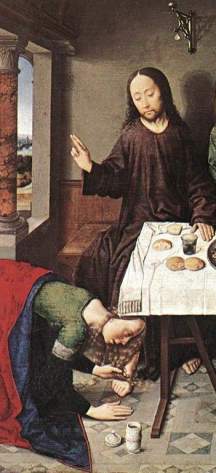 The word ‘Wednesday’ comes from the Northern European god Woden, known to the Romans as Mercury: he is the messenger God, the go-between. To be mercurial means to be volatile, changeable. Wednesday is the fourth day of the week: the day between the first three days and the last three days of the week. It is the turning point.
On the Wednesday of Holy Week, three decisive, history-shaping human events take place: 1.) The Sanhedrin decides to kill Jesus. This body of leaders had been building up to it for a long time, but on this day, the decision is made. 2.) Mary Magdalene, out of a very different place of decision, brings a very expensive alabaster jar of nard oil, breaks it open and anoints Jesus for his death. 3.) Judas decides to betray Jesus in order to push him to reveal his power fully, to reveal himself as the King of Kings.
A day of the turning point. We can ask ourselves, too, what we experience in our souls when we reach a turning point, when a great change is imminent, when something needs to change or die, that new life can break through. Our destiny often brings difficult, sometimes almost unbearable situations to culmination in these moments. Do we struggle to avoid them at all costs? Do we try to force the outcome that we’d prefer? Can we, in calmness and openness, look at such situations and ask: what wants to happen here, what needs to take place?
The Sanhedrin want to avoid the death of their culture threatened by an individual calling for a renewal of life, and they seek to eradicate their problem by destroying the one responsible. Judas wants to force this hoped-for new life to come now and in a way that he imagines it. He misinterprets the signs, for which he will soon suffer unbearably. But Mary Magdalene, being laid bare by grief and love, is the only one able to rightly recognize what is called for in the moment. And without concern for the non-essential (in that moment, the earthly expense for so much oil), she is able to do some good, and helps Jesus meet the future that is coming towards him, and that he is moving towards.
From time to time all human beings are called to be present and to act in such biographical moments. In general today, as human beings, we stand in such a great moment together. We are being asked to begin to awaken, to learn to discern the essential that needs to be done in every moment of our brief and precious lives.
 becomelikeaflame